Sign up for Solidarity Newsletter


Against the Current

Published bimonthly since 1986, AGAINST THE CURRENT is a Solidarity-sponsored analytical journal for the broad revolutionary left. The Sept./Oct. issue features Malik Miah on How Race Fuels the Rightist Agenda, Kit Adam Wainer on Obama's Race to the Top vs. Teacher Unions and Susan Spronk and Jeffery R. Webber interviewing Venezuelan activists Gonzalo Gómez, Stalin Pérez Borges and Luis Primo on the processes of deepening the revolution. Coverage of The Mexican Revolution at 100 continues, featuring an interview with Adolpho Gilly and articles by Dan La Botz, James D. Cockcroft, Heather Dasner Monk, Fred Rosen and Scott Campbell.

See the latest issue...
View the archives...
Subscribe!
Write a letter to the editor...

International Viewpoint is the monthly English-language magazine of the Fourth International. IV is a window to radical alternatives world-wide, carrying reports, analysis and debates from all corners of the globe. Correspondents in over 50 countries report on popular struggles, and the debates that are shaping the left of tomorrow.

Put a Socialist in the Senate!

LaBotz, Buckeye Socialist, Senate 2010

Dan La Botz, a 64-year old Cincinnati school teacher, has filed petitions with the Ohio Secretary of State to become the candidate of the Socialist Party for the U.S. Senate. La Botz, who needed 500 signatures to get on the Socialist Party primary ballot, filed petitions with approximately 1,200 signatures on Thursday, Feb. 18. La Botz, a long time labor and social movement activist, is the candidate of the Socialist Party of Ohio which is the state organization of the Socialist Party USA.

Read more...
Keep up with the campaign!
Campaign website- DanLaBotz.com

Order these eye-catching buttons to spread the demand for social and economic justice. If you don't have paypal, email us!


Reads Bail out People, not Wall Street!. Around the edge, these 2 1/8" buttons read "Free Health Care," "Defend Public Services," "Living Wage Jobs," "Free Higher Education," "Troops Home Now," "Rebuild the Gulf Coast," and "Affordable Housing."

Brown and black buttons demand: "Bring all the Troops Home Now!" Wear one everywhere to start a conversation about why US occupation can never be a force for liberation, and people's needs should come before the massive military budget.

Quantity

These 2 1/8" buttons read, in Spanish and English: ¡Alto a las deporaciones - Legalización para todos! Stop the deportations - Legalization for all!

Quantity

Videos from Solidarity's Educational Conference

November 14-15 in New York City, Solidarity held a successful conference featuring engaging talks on a number of topics. Click here to view these videos from "Their Crisis, Our Movements"

- Crisis of Capitalism, Challenge to the Movements (David McNally, New Socialist Group)
- The New Imperialism and The Global Fightback (Vivek Chibber, Christy Thornton, Jonah McCallister-Erickson)
- The State of Resistance in Communities & the Workplace (Normahiram Perez, Steve Downs, Penelope Duggan)
- Race and National Liberation Under Obama (Glen Ford, Lalit Clarkston)

Donate

Solidarity depends on the generous contributions of its friends and allies to continue its work. Please consider giving!

User login

Barbara Zeluck Presente!

Our comrade Barbara Zeluck died June 5, 2010. She was a lifelong socialist and founding member of Solidarity. Barbara had a long and active life, unwavering in her support for radical social change and movements that she felt were dedicated to mobilizing the working class and raising class consciousness. She always believed that a better world was possible. Read More...

One Year of Obama and the Democrats’ Debacle

Last fall, in the discussion that produced our analysis of “Obama After 200 Days,” we said it would be premature to speak of a “crisis” for the administration. A year after the euphoric 2009 inauguration, it no longer looks premature. People who looked to Obama and the Democrats for leadership are bitterly disappointed, and a very peculiar brand of rightwing politics has seized the initiative.
Read more...

Regroupment & Refoundation of a U.S. Left

As part of the preparation for our 2008 Convention, members of SOLIDARITY have begun a political document describing some perspectives for socialist renewal in the twenty-first century. We welcome responses to this initial draft of the document. Some of the themes here have also been developed in Solidarity's Founding Statement and our 1997 pamphlet, “Socialist Organization Today.”

New Pamphlet: Hell on Wheels

New from Solidarity! Long time transit worker activist Steve Downs has written a pamphlet charting the twenty year story of New Directions, a rank and file caucus in New York City's transit union that he helped build and develop - including the challenges of keeping the rank and file democracy movement alive after New Directions won control of the local.

Read an interview on Zmag.org
Read a review and order your copy today!

From Abortion Rights to Reproductive Justice

New from Solidarity's Feminist Commission, this leaflet responds to the right wing attack on reproductive freedom and argues that the movement must go beyond "pro-choice" to true reproductive justice. This socialist and anti-racist feminist agenda would take up issues such as access to health and child care, forced sterilization, and the division of "productive" and "reproductive" labor.
Download the pamphlet...

Update on Pakistan

Read more about Pakistan's political crisis at the bottom of this page.

Zero fervor for elections

By: Farooq Tariq - February 5, 2008

Thirteen days to go and yet there is no election excitement. There are no street corner meetings or large-scale public rallies. The main leadership of those parties participating in the elections plan no national tours. It could be the most colorless election in the history of Pakistan.

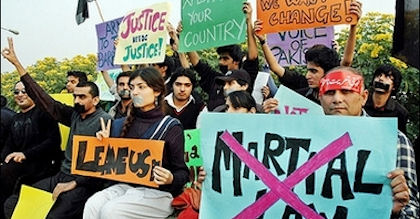
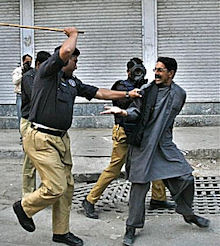
The reasons are simple: General Musharraf wanted it that way. Before announcing the date for the general elections, he imposed martial law. He arrested over 10,000 political activists and lawyers, removed all the top judges, amended the constitution and got himself elected as “civilian” president. He wanted five more years in power.

General Musharraf’s allies made all the arrangement to “win” the elections before announcing the date. They wanted a snap election where the opposition would have no time to mobilizing its base. It was to be a general election held without an independent judiciary, with a dependent Election Commission, and with repression still alive. This was the ideal circumstance for a “win.”

Pressured by American and British imperialism, Musharraf was forced to implement a power-sharing deal with the Benazir Bhutto and the Pakistan Peoples Party (PPP). However, supporters of military rule, having enjoyed all the power during Mussharraf’s first eight years, opposed the deal, dragged their heels and set up hurdles.

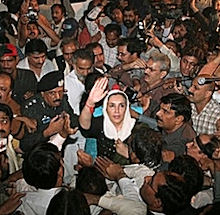
Following Musharraf’s imposition of emergency law, the lawyers’ movement rightly demanded that political parties boycott the fraudulent election. The majority agreed, including former prime minister Nawaz Sharif and his Muslim League (PMLN). But the PPP kept its bargain and Benazir Bhutto began her vigorous campaign. It was her unfortunate assassination on 27 December 2007 that shocked the whole world. Had the PPP leadership then demanded Musharraf’s immediate resignation, he would be gone by now.

Following Benazir’s assassination the PPP leadership wanted to cash in on sympathy votes and demanded that the 8 January election not be postponed. Nonetheless the Election Commission proposed the general elections until 18 February 2008, providing Musharraf supporters with a breathing space.

The mass reaction after Benazir Bhutto’s death opened the lid on the economic crisis: There was shortage of everything, from wheat flour to electricity. Musharraf’s claim that he provided eight years of uninterrupted economic boom was shattered within few days. The long queues in front of public Utility Stores a cross Pakistan revealed the desperate situation the masses were living in.

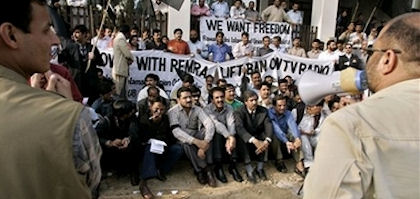
The lawyers’ movement did not retreat. It has continued to demand the release and reinstatement of the country’s top judges. They are still actively supported by civil society organizations and the students. Despite the reality that the lawyers’ demand is one of the most popular issues of the day, both the PPP and PMLN decided to participate in the February general election.

The combination of Benazir Bhutto’s assassination, the economic crisis and the boycott appeal of both the lawyers movement and the All Parties Democratic Movement has minimized election fervor. If the 18 February election does take place, the PPP will get a massive sympathy vote from those going to the polls. But not much will change because the PPP leadership has already made it clear that it is willing to work with Musharraf.

The PPP has nothing to offer to the people of Pakistan. It believes in privatization and it is happy to go along with the imperialist policies for the region. In fact this is not a new turn for the PPP; it has gone along with these policies for long time. The same is true for Nawaz Sharaf’s PMLN. In fact all those participating in the elections share one common goal with Musharraf: a continuation of the present economic “reforms.”

All those on the Left who expected an election where there would be a mobilization of masses and, consequently, a chance to work among them must be very disappointed. This is not an ordinary general election. This is a very calculated plot on the part of the Musharraf dictatorship to continue for the next five years with the collaboration of those who will be “elected.” This is not an election that can mobilize the masses to build a movement that could overthrow the dictatorship after the elections. But there is a growing movement against the military dictatorship.

The Pakistan Peoples Party is paying the price of its participation in the election, at least among the most active strata of society. The PPP lawyers once had the support of over 80 percent of Bar Association of Pakistan. However, recent Bar Association election results reveal an opposite trend.

The Lahore Bar Association elections show that the PPP-nominated president got less than 400 votes. The Awami Jamhoori Tehreek, (the Left alliance) candidate received 1075 and lost by less than 100 votes. Another anti-Musharraf candidate, suppored by the Imran Khan grouping, won the presidency. The brother of “Marxist” PPP former Member of Parliament (the Ted Grant group) was also badly defeated for Qasur Bar Association president. The Labour Party Pakistan Punjab chairperson received the highest number of votes for the executive board.

At the Multan High Court Bar Association meeting on 4 February, the Bar’s president attempted to defend the PPP decision to participate in the fraudulent February election, agitating lawyers forced him to stop speaking. Earlier, in another incident at Lahore University of Management, the PPP and PMLN representatives had to face angry students and civil society activists who were shouting for a total boycott.

So far the election campaign is limited to newspaper and television advertisements, billboards, stickers, banners and posters. There are no local public meetings. Unlike in the past, the candidates’ temporary offices look deserted. The PPP is counting on sympathy votes and it believes that it does not need a mass public campaign, as was the case in the past. At the same time both the PPP and PMLN are already complaining about Musharraf’s supporters plan to rig the vote.

The lethargy toward this election is a phenomenon that deserves serious examination. How many would go to the polls has to be seen, but it is clear from all indicators that it will be the most hollow election in the history of Pakistan.

Can Musharraf Survive?

By: Farooq Tariq

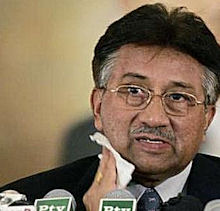
It seems that Musharraf is on his last leg. He has become the most detested and despicable president in the history of Pakistan. No longer are there progressives, liberals or moderates in his camp. His enlightened moderation has been buried with the passage of time.

Musharraf is unloved even by most religious extremists. His previous policies gave them space into which they have moved aggressively. But Washington demanded that he suppress them in order to prove his usefulness to U.S. imperialism and he did so. However he did not please either Washington or the extremists.

The economic crisis has isolated him from the vast majority of ordinary Pakistanis, including formerly close associates. His traditional support among the stock exchange and Chambers of Commerce has evaporated. They are no more his enthusiastic supporters.

Musharraf's comments about democracy during his nine-day European tour (starting 20 January 2008) has annoyed democrats inside and outside Pakistan. The comment that the “West is obsessed about democracy” was a direct insult to the people of Pakistan but his sarcastic and taunting tone did not please his European friends. Gone are the days when he could say any nonsense and get away with it!

His recent comment echoed his remark during his 2006 U.S. tour, where he managed to annoy women organizations inside and outside Pakistan. He had prevented Muktaran Mai, who was gang raped on the order of the local Punchait, from leaving Pakistan. In explaining his action he told reporters that the impression was that she had gotten "raped in order to get a visa.”

The recent murder of Benazir Bhutto was a shock to many of the European governments that had been friendly to Musharraf. He had previously projected the image that he was their much need friend in the war on terror. But the unprecedented reaction to Benazir's brutal assasination is shattering his image at home and abroad.

The U.S. and British governments' projected Plan A for maintaining stability in Pakistan was built on the unholy governing combination of Benazir and Musharaf. This has come undone by the Benazir assassination. There seems to be no Plan B. Has Musharaf outlived his usefulness to his imperialist masters? His tour of Europe may be an attempt to reassure his colleagues in Pakistan that he is still able to secure the support of his European friends. One recalls a similar trip to Washington in October 1999 by Nawaz Sharif, just before his overthrow.

Musharraf's repeated assurances that nuclear weapons are in safe hands and the army cannot be defeated by religious fundamentalists illustrates the concerns of the friendly European countries. His trip is to address these worries by putting on a “brave” face. However, his justification in imposing the emergency, disposing and arresting the country's top judges, arresting thousands and curbing the media will satisfy none. Now he is imposing democracy as he imposed the emergency, bringing democracy with the barrel of his gun.

In the face of the proposed 18 February 2008 general elections there are two political camps: those participating and those boycotting. The massive turnout at the boycott meeting by All Parties Democratic Movement on 22 January in Loralai, Baluchistan indicates that the boycott campaign is picking up steam. This was the fourth successive APDM mass rally in Baluchistan.

The Pakistan Muslim league Q (PMLQ), Musharraf's favorite, is in absolute crisis after the recent shortages of food items, electricity and gas. The PMLQ candidates are the target of anti-Musharaf consciousness. The general perception is that if you are against Musharraf, do not vote for the PMLQ. Following Benazir's assassination, the wave of sympathy has opposed the PMLQ.

Unless there is an all-out rigging of the election, there is no guarantee that Musharraf's supported candidates will win the election. If Pakistan Peoples Party and Pakistan Muslim league Nawaz (PMLN) candidates gain a majority in the next parliament, Musharraf will find very difficult to repeat what he did following the 2002 election, when he bribed many PMLN and PPP parliamentarians to join hands with the PMLQ to form a majority government. At that time, shortly after 9/11, Musharraf's military regime was supported by both U.S. and European governments. But in 2008 he is seen standing in the wind. It will be difficult for any parliamentarian elected on anti-Musharraf feeling to cross over to his camp.

Boycott, or no boycott, the future scenario seems more and more problematic for Musharraf. His departure seems written on the front door of every home. Only another 9/11-like situation could alter his fate. Students are awakening and so is the trade union movement. That, combined with the pressure from the lawyers movement and growing participation by civil society, may succeed in pushing Musharraf from power.

Pakistan may take a page from their nearby Nepalese brothers and sisters. “If they can get rid of the King, why can not we do it here with the military dictatorship?" is the question many of the activists ask.

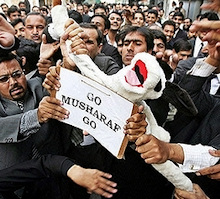
Let's do it Nepalese way: with a peaceful massive movement everyone can get out into the street and make it clear that Musharraf must go. “Go Musharraf Go."

Pakistan Collapsing, Musharraf Must Go

By: Farooq Tariq

PAKISTAN IS ON the fast track to collapse under the Pervez Musharraf dictatorship. The state is in immense crisis. The infrastructure, industrial and social, is in total chaos. The economic crisis is showing its muscles. Inflation is uncontrollable and unemployment is ever increasing.

The vast majority of ordinary people of Pakistan believe that he will never leave power alive: “If he is not killed, he will kill us all one by one.” He has become the most unpopular president of Pakistan. Musharraf is widely seen as a person who has orchestrated the murder of Benazir Bhutto. “Qaatal Qaatal Musharraf Qaatal” (“Murderer the murderer, Musharraf the murderer”) was the main slogan of the mass reaction.

All the twist and turns of the Musharraf dictatorship after the murder has strengthened the doubts of the masses in this regard. “He asked her to come to Pakistan by negotiating and let her be killed” is a remark you hear very often. Despite that, Musharraf has consistently shown that he will stick to power by any means: “He is the ultimate power,” “Pakistan needs him, Pakistan first,” “Pakistan my top priority” is some of his routine sloganeering.

Here in Pakistan, however, many do not trust him anymore here. The desperation of the masses to remove Musharraf is clear everywhere. The mass movement had attempted to throw him out of power after the assassination of Benazir. This was an unprecedented movement for five days from 27 December, 2007. Not a single shop was open, no wheel on the move, no factory working, no bank open, no office functioning, no restaurant or hotel open, no train on the move, flights cancelled, schools and colleges closed and thousands and thousands were on the road protesting -- this was the most unexpected outburst of mass anger after the killing.

Nevertheless, unfortunately, the Pakistan Peoples Party (PPP) leadership had not learned from history. They saw in this crisis an important occasion to show that they are the responsible defender of the system. They appealed to the masses to cool down, go back to their work and turn their anger into votes for the Pakistan Peoples Party.

This was the time when the majority of the political parties had declared a boycott of the elections and demanded Musharraf’s immediate resignation. Had the PPP joined other parties in boycotting the general elections, Musharraf would have gone by now.

They had not realized the post-assassination scenario or anticipated the total collapse of the economy in the following days. They had not thought of the tactics Musharraf’s supporters would use to rig the election if given the chance. In the Sind province (the PPP’s stronghold) alone, over 4000 First Investigation Reports (FIR) has been registered by police against a record number of half a million PPP and other opposition political activists. Many PPP activists were arrested to be released on bail later. Many thousands have gone to secure bail even before being arrested.

The tactics of the PPP leadership put the party in a defensive position. Three weeks after the Benazir Bhutto assassination, the PPP is on the run. Yet Musharraf had been on the defensive after the killing. He was relived when the PPP leadership took the decision to participate in the elections. At a time when the consciousness of the whole of Pakistan was anti-Musharraf, with the active participation in the mass movement, the PPP leadership’s announcement to participate in elections was like a fire truck putting cold water on the boiling heat.

Moreover, what kind of election is taking place on 18 February? Before the announcement of the general election, 60 top judges were put under house arrest on 3 November 2007 when martial law was imposed in the name of emergency; many are still in house arrest, particularly Chief Justice Iftikhar Ahmed Choudhry. As of 14 January, all public meetings and election rallies were banned for a month on the name of “security.” Thus, effectively, there is not going to be any mass campaigning by political parties.

Most of the opposition parties that are taking part in the elections are already complaining that it will be rigged, and that they have proof of rigging in the voting lists. All the rules laid out by the Election Commission of Pakistan about the size and width of the posters, pamphlets, stickers, signboards and banners have been widely violated by most of the candidates.

It is race of money among the candidates, like a business competition --not a democracy that is going to be restored by the election, but a mockery of democracy. The general election has given the masses a chance to choose among exploiters. The condition that a candidate must be at least a university graduate means that less than one percent of the whole population had a chance to become candidates.

Three weeks after the assassination of Benazir, on 17 January 2008, there is unprecedented price hikes for everything. Wheat flour, the most used food item in Pakistan, has shot up from 13 Rupees a kilogram to 25 to 50 Rupees, if you can find it in shops. After failing to buy the wheat flour from the government concessional utility store, some women have attempted suicide. Food riots have been reported in many parts of the country.

There is regular news on television and newspapers that “smugglers” of wheat floor have been arrested. Previously smuggling was normally restricted to gold and electronic items. Now wheat flour “smugglers” are the main enemies of Pakistan. Almost every province has restricted the transportation of wheat floor, creating more problems for the people of North West Frontier Province, Baluchistan and many in Afghanistan who are dependent on wheat flour from Punjab and Sind.

There are also massive electricity crises. Electricity is released on a load-shedding basis, with electricity available for 10 to 12 hours a day in most parts of the country. The countryside is worst hit by this shortage. There is no commercial gas available to industries for the last two weeks, thus closing down hundreds of factories. Even hospitals are not spared. Hundreds of thousands of workers have been laid off from the factories; they are asked to wait until electricity and gas is fully restored.

LPG gas has disappeared. The price has gone up from 50 Rupees a kilogram to 100/110 Rupees a kilogram, if you can find one LPG gas shop open. The price of one kilogram of vegetables has gone from 100 Rupees to 125 Rupees. There is almost a 25 percent price hike of everything available in shops and supermarkets. Yet there is neither a wage increase nor any temporary compensation for the people.

This is fertile ground for the very rich politicians from Muslim League Q, who are the main supporters of Musharraf. They will buy votes in bulk for the general election. The hardship of life under Musharraf, with the PPP taking part in the election, may cut across the massive sympathy wave that PPP is counting on.

The Musharraf dictatorship, however, has failed to curb the ongoing suicide attacks. Religious fundamentalists groups in Wazirestan and Swat are not backing down. Despite a heavy military operation, they are striking back repeatedly. On 16 January, a group of religious extremists occupied a fort in North Wazirestan, which was used by Pakistan military. The newspapers reported eight army men killed with 20 disappeared, while unconfirmed reports put the causalities much higher. The government reported 50 militants were killed.

There are several incidents where most of the suicide attackers have been less than 16 years of age. The completely new generation has been motivated by religious fundamentalists to make an all-out war against the friends of imperialism and “enemies of Islam.”

There is also much discontent among the police force and bureaucracy. They are sick and tired of being used against the masses. Many police officers speak against the Musharraf government to their friends and contacts. There is no support among the public employees for the military dictatorship, but they are forced to go on.

The Musharraf dictatorship is isolated and the most hated in the history of Pakistan. It is a dictatorship supported only by American imperialism and its allies. It is trying its best to survive. However, the days of the military regime are numbered. It cannot survive for long despite all the help of its political friends. Musharraf has survived through the most modern security arrangements available, but these will not work all the time in the wake of tremendous hatred that is building up.

Former Prime Minister Benazir Bhutto was assassinated Thursday, December 27.

Previous features on Pakistan's political crisis: