
Sign up for Solidarity Newsletter


Against the Current

Published bimonthly since 1986, AGAINST THE CURRENT is a Solidarity-sponsored analytical journal for the broad revolutionary left. The Sept./Oct. issue features Malik Miah on How Race Fuels the Rightist Agenda, Kit Adam Wainer on Obama's Race to the Top vs. Teacher Unions and Susan Spronk and Jeffery R. Webber interviewing Venezuelan activists Gonzalo Gómez, Stalin Pérez Borges and Luis Primo on the processes of deepening the revolution. Coverage of The Mexican Revolution at 100 continues, featuring an interview with Adolpho Gilly and articles by Dan La Botz, James D. Cockcroft, Heather Dasner Monk, Fred Rosen and Scott Campbell.

See the latest issue...
View the archives...
Subscribe!
Write a letter to the editor...

International Viewpoint is the monthly English-language magazine of the Fourth International. IV is a window to radical alternatives world-wide, carrying reports, analysis and debates from all corners of the globe. Correspondents in over 50 countries report on popular struggles, and the debates that are shaping the left of tomorrow.

Put a Socialist in the Senate!

LaBotz, Buckeye Socialist, Senate 2010

Dan La Botz, a 64-year old Cincinnati school teacher, has filed petitions with the Ohio Secretary of State to become the candidate of the Socialist Party for the U.S. Senate. La Botz, who needed 500 signatures to get on the Socialist Party primary ballot, filed petitions with approximately 1,200 signatures on Thursday, Feb. 18. La Botz, a long time labor and social movement activist, is the candidate of the Socialist Party of Ohio which is the state organization of the Socialist Party USA.

Read more...
Keep up with the campaign!
Campaign website- DanLaBotz.com

Order these eye-catching buttons to spread the demand for social and economic justice. If you don't have paypal, email us!


Reads Bail out People, not Wall Street!. Around the edge, these 2 1/8" buttons read "Free Health Care," "Defend Public Services," "Living Wage Jobs," "Free Higher Education," "Troops Home Now," "Rebuild the Gulf Coast," and "Affordable Housing."

Brown and black buttons demand: "Bring all the Troops Home Now!" Wear one everywhere to start a conversation about why US occupation can never be a force for liberation, and people's needs should come before the massive military budget.

Quantity

These 2 1/8" buttons read, in Spanish and English: ¡Alto a las deporaciones - Legalización para todos! Stop the deportations - Legalization for all!

Quantity

Videos from Solidarity's Educational Conference

November 14-15 in New York City, Solidarity held a successful conference featuring engaging talks on a number of topics. Click here to view these videos from "Their Crisis, Our Movements"

- Crisis of Capitalism, Challenge to the Movements (David McNally, New Socialist Group)
- The New Imperialism and The Global Fightback (Vivek Chibber, Christy Thornton, Jonah McCallister-Erickson)
- The State of Resistance in Communities & the Workplace (Normahiram Perez, Steve Downs, Penelope Duggan)
- Race and National Liberation Under Obama (Glen Ford, Lalit Clarkston)

Donate

Solidarity depends on the generous contributions of its friends and allies to continue its work. Please consider giving!

User login

Barbara Zeluck Presente!

Our comrade Barbara Zeluck died June 5, 2010. She was a lifelong socialist and founding member of Solidarity. Barbara had a long and active life, unwavering in her support for radical social change and movements that she felt were dedicated to mobilizing the working class and raising class consciousness. She always believed that a better world was possible. Read More...

One Year of Obama and the Democrats’ Debacle

Last fall, in the discussion that produced our analysis of “Obama After 200 Days,” we said it would be premature to speak of a “crisis” for the administration. A year after the euphoric 2009 inauguration, it no longer looks premature. People who looked to Obama and the Democrats for leadership are bitterly disappointed, and a very peculiar brand of rightwing politics has seized the initiative.
Read more...

Regroupment & Refoundation of a U.S. Left

As part of the preparation for our 2008 Convention, members of SOLIDARITY have begun a political document describing some perspectives for socialist renewal in the twenty-first century. We welcome responses to this initial draft of the document. Some of the themes here have also been developed in Solidarity's Founding Statement and our 1997 pamphlet, “Socialist Organization Today.”

New Pamphlet: Hell on Wheels

New from Solidarity! Long time transit worker activist Steve Downs has written a pamphlet charting the twenty year story of New Directions, a rank and file caucus in New York City's transit union that he helped build and develop - including the challenges of keeping the rank and file democracy movement alive after New Directions won control of the local.

Read an interview on Zmag.org
Read a review and order your copy today!

From Abortion Rights to Reproductive Justice

New from Solidarity's Feminist Commission, this leaflet responds to the right wing attack on reproductive freedom and argues that the movement must go beyond "pro-choice" to true reproductive justice. This socialist and anti-racist feminist agenda would take up issues such as access to health and child care, forced sterilization, and the division of "productive" and "reproductive" labor.
Download the pamphlet...

State of Emergency and Crackdown on Political Activists in Pakistan

On November 3, Pervez Musharraf, the president of Pakistan, declared a state of emergency and suspended the constitution in the face of protests against his attempted re-election while remaining army chief. Musharraf came to power following a 1999 military coup d'etat and since 2001 has been a key U.S. ally in the region. These recent actions lay bare the hypocrisy of the supposed democratic aims of the "War On Terror." Below, British socialist Tariq Ali reflects on the meaning of the state of emergency.

Prior to the state of emergency, Against the Current interviewed Farooq Tariq, the leader of the Labour Party of Pakistan, about the political situation there.
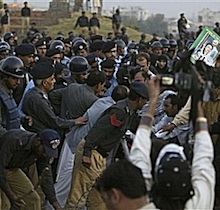
For anyone marinated in the history of Pakistan yesterday’s decision by the military to impose a state of emergency comes as no surprise. Martial law in this country has become an antibiotic: in order to obtain the same results one has to keep doubling the doses. This was a coup within a coup.

General Pervez Musharraf ruled the country with a civilian façade, but his power base was limited to the army. And it was the army Chief of Staff who declared the emergency, suspended the 1973 constitution, took all non-government TV channels off the air, jammed the mobile phone networks, surrounded the Supreme Court with paramilitary units, dismissed the Chief Justice, arrested the president of the bar association and inaugurated yet another shabby period in the country’s history.

Why? They feared that a Supreme Court judgment due next week might make it impossible for Musharraf to contest the elections. The decision to suspend the constitution was taken a few weeks ago. According to good sources, contrary to what her official spokesman has been saying ("she was shocked"), Benazir Bhutto was informed and chose to leave the country before it happened. (Whether her “dramatic return” was also pre-arranged remains to be seen.) Intoxicated by the incense of power, she might now discover that it remains as elusive as ever. If she ultimately supports the latest turn it will be an act of political suicide. If she decides to dump the general (she accused him last night of breaking his promises), she will be betraying the confidence of the US state department, which pushed her this way.
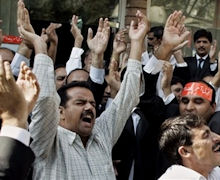
The two institutions targeted by the emergency are the judiciary and the broadcasters, many of whose correspondents supply information that politicians never give. Geo TV continued to air outside the country. Hamid Mir, one of its sharpest journalists, said yesterday he believed the US embassy had green-lighted the coup because they regarded the Chief Justice as a nuisance and “a Taliban sympathiser”.

The regime has been confronted with a severe crisis of legitimacy that came to a head earlier this year when Musharraf’s decision to suspend the Chief Justice, Iftikhar Hussain Chaudhry, provoked a six-month long mass movement that forced a government retreat. Some of Chaudhry’s judgments had challenged the government on key issues such as “disappeared prisoners”, harassment of women and rushed privatisations. It was feared that he might declare a uniformed president illegal.
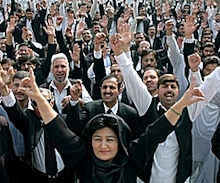
The struggle to demand a separation of powers between the state and the judiciary, which has always been weak, was of critical importance. Pakistan’s judges have usually been acquiescent. Those who resisted military leaders were soon bullied out of it, so the decision of this chief justice to fight back was surprising, but extremely important and won him enormous respect. Global media coverage of Pakistan suggests a country of generals, corrupt politicians and bearded lunatics. The struggle to reinstate the Chief Justice presented a different snapshot of the country.

The Supreme Court’s declaration that the new dispensation was “illegal and unconstitutional” was heroic, and, by contrast, the hurriedly sworn in new Chief Justice will be seen for what he is: a stooge of the men in uniform. If the constitution remains suspended for more than three months then Musharraf may be pushed aside by the army and a new strongman installed. Or it could be that the aim was limited to cleansing the Supreme Court and controlling the media. In which case a rigged January election becomes a certainty.

Whatever the case, Pakistan’s long journey to the end of the night continues.
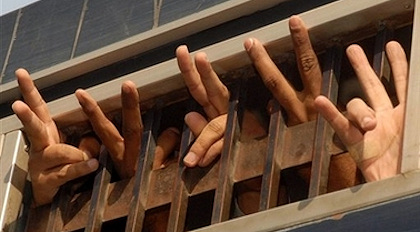
More Information: