
by Ryan Hill
December 24, 2011
As I write this, hundreds of thousands are ready to gift Amazon-bought items to friends and relatives for the holidays. While CEO Jeff Bezos had a part in creating this retail powerhouse, he’s no jolly, gift-bestowing Santa. To the workers who move millions of products through the Amazon logistics chain day and night, he’s more like the Krampus, pursuing and punishing the “bad children” who fail to meet insanely high production rates with write-ups and layoffs, often in that order.

The Krampus, a frightening figure of pre-Christian Germanic origin that happens to also bear striking resemblance to Jeff Bezos and other members of the 1%.
Behind their user-friendly website is a network of worker-unfriendly warehouses responsible for circulating the commodities (everything from lettuce to e-readers) that generate billions in profits for its executives and investors. In Amazon-speak, the warehouses are “fulfillment centers,” where the desires of its customers are fulfilled by a lean logistics chain that cuts costs at almost every turn. Earlier this year, journalists and advocates brought literal sweatshop conditions to light at several warehouses where the summer heat wave brought temperatures up to over 100 degrees. Even with workers falling from heat exhaustion, Amazon refused to do basic things, such as installing sufficient fans, tolerating slower production rates, or opening docking doors to improve airflow.
From that hot summer, we enter a cold winter, where the company has just laid off thousands of temporary workers after its peak season. Amazon keeps the majority of its workers in temporary status, technically employed by Integrity Staffing Solutions. As employees unload, stow, pick, sort, pack, and load (in that order) over the last week, managers moved from department to department explaining to workers that their production rate is below the desired level (rising every week) and that their assignment has come to an end. Some of them had been hoping to make the cut for conversion to Amazon employees, and left in a show of anger–most left silently, taken without notice, realizing that the pace and physical demands of the job weren’t for them anyway. At most facilities, the final wave of layoffs of hundreds at a time happened several days ago–in lieu of a severance package, $5 Amazon gift cards were offered.
I know this because I briefly worked at one of these fulfillment centers, enduring mandatory 60 hour shifts, monotonous tasks, constant surveillance, and seemingly daily performance reviews by a battery of Amazon and Integrity managers. The state of Tennessee and city of Chattanooga offered up a stew of tax incentives, free land, and other varieties of corporate welfare to entice Amazon to plant its next “fulfillment center” there and hire locals.

The fulfillment centers are typically huge and employ thousands during peak season.
While many blue collar jobs in manufacturing have been outsourced or roboticized, logistics jobs continue to grow in the US in response to a consumer market hungry for cheaper goods. Unlike these blue collar jobs of the past, there are no entrenched unions for companies to fear. As a result, the jobs offered (temporary or not) are no different than the majority of other low wage, no benefits positions offered to workers in any other sector. They don’t raise standards and don’t offer any mobility for advancement.
I was a picker, speed-walking from bin to bin, scanning items to send down the conveyor belt to sort, like some bizarro supermarket sweep that never seemed to end and only resulted in $5 Subway gift cards for top rates. As the promise of Subway gift cards implies, we were all treated like children. Managers sent messages on our scanners addressed to “kids,” no matter that a quarter of the department was old enough to have grandchildren. However young many workers were when they entered the warehouse, they left with adult problems–back aches, leg and foot pain, and other marks of repetitive stress and long shifts spent on concrete floors.
Most of the co-workers I talked to incurred several “points” for missing shifts due to these aches and pains. Many of us were also charged points for being a minute late to work, or back from lunch, even if it was just due to long lines at the time clock or security screening (imagine if you had to go through the TSA line for every break–that’s what it felt like, sometimes!). It’s quite easy to rack up enough points to result in termination, and by design–this way, Amazon generates a high turnover rate so that workers can be perpetually denied benefits, conversion from temporary status, and any sense of job security. A fellow picker summed it up in one sentence: “It’s like we’re all disposable.”
Of course, Amazon is no exception. Almost all of these characteristics could be seen in warehouses across the country, as Dave Jamieson reports in his excellent article, “The New Blue Collar: Temporary Work, Lasting Poverty and The American Warehouse.” Warehouse Workers for Justice, a United Electrical Workers (UE) organizing project in Chicago, has also contributed detailed reports about the industry in Will County, Illinois, the top logistics location in the US. Though the Teamsters union has typically organized workers in related sectors such as parcel and freight, there have yet to be significant inroads on warehouse organizing. Union density in both transportation and warehousing has declined from about 26% in 2000 to just over 20% in 2011, with only a small portion of that total percentage in warehousing.
What would it take for workers to gain some footing in this sector? The specific conditions of warehouse work (temporary status, ease of electronic surveillance, high turnover, de-skilled jobs, etc.), combined with the overall economic conditions of low wages and high unemployment, present serious challenges to unions. Since unions generally have a shrinking dues base, organizing projects like these appear to be a risky investment. Workplaces with more stability–a rapidly shrinking target–attract the attention of staff organizers and researchers instead. To many folks who want (and need) bigger and bolder unions, this is a losing strategy–but to the more pragmatic forces within the movement, it’s going wherever growth is possible in a rapidly changing economy that favors capital more and more. Some of these same “pragmatic” voices also view contributions to the Democratic Party as a safe investment though, so go figure…
Perhaps this is why much of labor’s political momentum in recent months has come from “outside,” thanks to the Occupy movement. It’s allowed for the development of some shared space–independent of the Democratic Party and electoral campaigns–between students, unions members and staff, community organizations, and the many thousands of unorganized workers and unemployed who lack an organic connection to organized labor. It’s my wish that this shared space, political momentum, and the discourse of “the 99% vs. the 1%” will translate into prioritizing bolder organizing projects in sectors like warehousing. Not only do warehouse workers desperately need it, but so does labor if it hopes to remain relevant.

The recent use of the port shut-down tactic on the West Coast (though not without its own challenges) also brings to mind the potential leverage of logistics workers, who operate critical “choke points” in a circulation network that is stretched as thin as it can be in order to maximize profit.
Every peak season night at the Chattanooga warehouse, workers pushed through nearly 250,000 items to customers expecting speedy delivery and managers marked every single minute of lost production from time spent in longer breaks than allowed. If just one shift in one warehouse was lost, it would mean hundreds of thousands of customer complaints and an overflow of goods in facilities that rely on “cross-docking” to make room for future shipments. Dave Jamieson quotes an organizer with UE who knows the score:
“Despite the fact that these workers are paid poverty-level wages, we estimate that about a trillion dollars comes through Chicago on an annual basis…That’s about $6 million per warehouse worker. Each worker is responsible for moving $6 million worth of goods through that supply chain. These are the workers who, collectively, if they don’t show up for a day, these companies would stand to lose a lot of money…That’s something these companies need to pay attention to.”
To phrase it in a seasonally appropriate manner, all I want for Christmas is a revival of labor’s militant spirit in 2012. (I suppose a job with living wages and health care would be nice, too.) I’m not posting my wish list on Amazon.com, though–I’m sending it to all you out there who can make it happen!
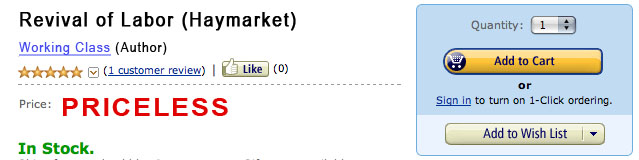
The situation has never in my short lifetime looked better to go “all in” to confront inequality and the decline of workers’ political power. It certainly seems like mass-based militancy anywhere could expand the opportunities for new projects everywhere, so wherever you are, let’s get to work!
Ryan, a member of the Solidarity Webzine editorial group, lives in Northwest Georgia and recently added another position to the long list of crappy jobs he has briefly held since he was 16. He was mostly nice in 2011.
Comments
17 responses to “An Amazon.com Worker’s Wish List”
If you’re not a student looking for a temp job you plan on quitting after a few months then I don’t recommend you apply as a temp to get your foot in the door. It is very difficult to convert to a blue badge unless your FC is struggling to find new temps. I was really lucky that I was able to keep my temp job during Peak season because I just sucked as a Stower due to over filled bins. But I was switched to Picking the week I was about to get fired which erased all the write ups for low rates that I received. After Christmas a bunch of workers both blue/white quit plus a lot of blue badges went on their holiday. So my FC kept a lot of temps I’m sure they wanted to get rid of.
I continued working for Amazon as white badge for about nine months before I was told my name was on the conversion list. I’m really looking forward to having health benefits that my blue badge co-workers get to enjoy for doing the same amount of work as me. As well as taking part in the free computer courses offered to blue badges. In those nine months everyone who went through training with me (back in October 2015) were fired. Some I would miss others not so much. They fired a co-worker who volunteered to work overtime. I thought that was a huge slap in the face.
Amazon FC put up recruitment flyers up in the lunch room looking for workers to recommend Amazon to anyone they know. I decided to check out the what the hiring process was like for Amazonians who are automatically permanent workers and found that it is just as easy to get hired as a permanent work as it is for you to get hired as a temp (they don’t give you an interview only a background check). What’s the difference you ask well benefits for one. You also get more vacation hours, more pay (by at least 25 cents) to take part in Amazon Career Choice program, and you get swag bucks you get to use to by Amazon merchandise like t-shirts that says you survived Peak 20Blah. That is what annoys me the most as being a temp, you don’t get any perks. But you get to watch other people enjoy them.
Recently they hired a bunch of new white badges. I see them rushing around trying to get a to a bin before their blue timer runs out. I wonder which ones will still be here in a few months before SMX/Amazon decides that their time is up.
Hi.
I worked under integrity at the amazon warehous
then converted to Amazon employee.
Now I have gotten my third warning about
quality so I guess I know what the
next step is. Does amazon give any
severance if you are there less then a year?
(not talking about the pay to quit program)
I can concur about the rate being pushed to be faster and faster (and let’s not mention that if your production rate is 99% or below for three consecutive weeks in a row, you get written up), and that the “error” system is flawed. I can, however, settle your mind that the auditors, who are actually members of the ICQA (Inventory Control, Quality Assurance), ARE held accountable for mistakes they may make. The inventory control process actually includes three steps. First, the Simple Bin Count (SBC) ICQA member counts the total number of items in a bin after items are stowed. If the number is anything different than what it SHOULD be, the pod is referred to Cycle Count, where they scan every item in the bin, and surrounding bins. If anything is still off, they have Simple Record Count (SRC) count the number of a specific item in that bin, and surrounding bins. With the three step process, the item is normally found in one of the surrounding bins and marked as an error on the last Stow or Pick associate who came in contact with the item. Inconsistencies are noticed this way, as all three counts have to be consistent. If that specific item is passed by SRC, and the SRC member makes a mistake, the next Pick member to come across the bin will mark a mistake and it will start the whole process over. It’s a system of checks and balances. And as far as write ups go….when you get written up, and you sign, the only thing you sign is your log in….which is something readily accessible to a person who is doing said writing up. All they have to do is type your log in into the line and Voila, you’re written up and you have no idea. One of my fellow co-workers made it all the way to his 3rd written write up without knowledge he had ever been written up, and got fired upon notice of the 3rd written write up.
All in all, I’ve enjoyed working for Amazon, and it keeps me busy and pays my bills. Its work not playtime, so fun isn’t expected in my mind. If you can’t be productive, keep your head down and not talk, and you have problems with physical labor, this job isn’t for you. If you can’t show up to work on time on scheduled days, this job isn’t for you. If you can produce, work hard, perform labor for endless hours, show up on time and stay for the whole shift, it’s possible. But it is agreed, that just like any other job that is out there, there are flaws. The only thing you can do is your 120% best and cross your fingers that the system weeds out the people who don’t.
Working at Amazon FC’s for any length of time requires a special person. Working at Amazon FC’s NIGHT SHIFT 630pm-aprox 530am, requires an even more special type of person. First, even more so at night, people are miserable, nobody really wants to be there no matter what the pep rally’s they have are before shift and lunch. Hours certain parts of the year are insane, as is the lunchroom at those times. By the time you get to the café through all the detectors and lockers and get to a microwave and even sit down to eat you lost 10 minutes min. Then bathroom time, either cigarette time or just a second or two to relax, and it’s another 5 hours or so that you’re running. SO you run from the time you get there to the time you leave. Yes, there are a lot of slackers, but they generally weed themselves out unless of some special circumstance.
Yes, there is favoritism and harassment, subtle and not so subtle, but honestly, I think it’s on par with most warehouse type work. Management doesn’t approve of it and will try to help. Most the harassment I have personally seen is from other employees, not management. What happens is people who have strong friendships get in with each other and just like kids, gang up on others for any reason. I look white, but I’m half Spanish and understand most of it. The things people have said about me, my own half brother’s and sisters, right aside of me thinking I don’t know, unbelievable. Why? because I’m gay, but I’m a working, masculine, normal male who just happens to prefer men. ANY little thing they can dislike you for, they will. It’s usually a small group that poisons the air for most the others who wouldn’t care, then they are afraid to be to friendly with you or they will get turned on. Race, color, sexuality, what color car you drive, anything. I’ve shown nothing but kindness and respect to every employee there, but sure don'[t get it back. And night after night, little jabs and remarks, really get to you. The work and rush is bad enough.
AND because some people are very close and lots of couples, they tend to get the better, easier jobs when available. It’s not always the best candidate long term, it’s popularity or something more. And no, that’s not fair, but it’s just the way it is.
I been there over a year, 2 peaks. It is not easy, I’ve had a couple run ins with other employees who just blatently made profane, discriminatory ugly remarks to a friend standing next to me, in other words to me, but not said “to me”. That’s a big difference but not allowed either way and I have gone to my manager and they helped. You can’t enforce people’s thoughts, and most fc employees aren’t very bright, criminal historys- minor- prob got away with a lot more, low education, kids all over the place they can’t afford. And they’re miserable. I think of that, and the life I have out of work, and try to remind myself for what they pay and the excellent benefits, 401k, stock, etc, etc… it’s not as bad as it sometimes seems. but seeing someone promoted who is much less a good candidate as you are, factually, because of favoritism, discrimination or romance is just not right and it is extremely hard not to get a poor attitude over. Really they just use people and cross train them all they can, just in case. Like the carrot dangling in front of the rabbit. Work life in America is not the same and unfortunately prob will never be. You have to put your head down, work at a reasonable pace and keep up rates, show up, and you should be ok as long as you can put up with the ups and downs. There will be plenty I ASSURE you.
I too work at Mississauga Warehouse since last 6 months. Its the worst workplace that I have ever been to and such a horrible experience. Extreme mental torture with much physical exertion, you are walking dead at the end of your 10.30 hour shift. its not done yet, there is MOT almost every week, if not every week then at least thrice in month, just leaving 1 MOT day in behind. And, yes you are right, they have many reasons to get rid of you like productivity, Quality, Bin defect and blah blah blah….
I got my written ups at 96% and then they say,oooo u know what you can do it, you are so close. So let me ask them, if they are very sure of my potential or so concerned with my work, then why the F>>> they have to bring that weekly rate paper to me every hour for further harassment. They don’t leave any chance to piss you off. All and all they are concerned with their numbers and for them associate can go to hell, soon they are done with their shift.
I had to come home early today, coz of such mental stress and Since the very first day I feel that I could collapse anytime.
and yes ..a mile to walk to and from lunch room.
and then they want you to leave early from break, so you can reach your station. Much partiality in blue badge and white badge..
No matter, how much I would write or say, its less.
I don’t have words to create a clear picture to explain the severity of working at so called AMAZON.
So yes I am leaving shity work next week.
yeah…NEVER AGAIN
AWFUL
I think of all the jobs at an Amazon FC, Stow is the worst. It doesn’t require a whole lot of movement like pick or pack or sort, but they have to push these huge carts around small aisles around pickers who have priority because of getting orders out, and put the items from these carts in the bins the computer tells them to, whether it really fits or not. Stow gets blamed for a lot more mistakes than they make. Pickers for the most part are a lot of temps and people not there very long, and just don’t care. And they’ll pick something up off the floor, (maybe) and stick it back in any bin. And they basically work in a few aisles the whole night, so especially night shift for 11 hours, it’s a mind numbing job that you’re supposed to be on your toes for and not make any mistakes.
THE BEST WAY TO GET A FULL TIME JOB DIRECT WITH AMAZON AND KEEP IT: Show up every shift unless vacation or personal time, Make slightly above rate, not too much, and be ACCURATE. Other then that, keep your head down, don’t talk to people or get real friendly or look for a girlfriend or boyfriend or every ass walking down the center aisle, and punch in, take lunch, finish your shift, and go. Don’t complain, don’t make yourself the center of attention at anytime. Just shut up and do the best you can, and either you’ll make it or not.
You will constantly see people that are less as good as you in every way promoted or given easier work or jobs or positions just because of friendships or romantic reasons, so that’s gonna happen, and you have to roll with the punches and know that one day your chance will come. Don’t kill yourself, many many people last a few months and burn out, if that. Just take it easy and make rate and have quality. Keep to yourself except for a small group of workfriends. That’s my advice, but absolutely all jobs at Amazon, almost, have things that are unfair, borderline impossible to follow all the rules and requirements of the job at ALL times, and lots of times discriminate and aren’t fair with promotions and work, but I FEEL in my year and some there, that stowing is the worst. There’s just a lot of low class people there who like to make problems for others in suble and obvious ways and even disrespect you in front of others to make an ass out of you because they’re jerks, mostly real young. I’m almost 46 and do much much more and higher quality work than 22 year olds and show up more than they do. I’ve seen about half a turnover in 1 year, despite what Amazon says, if you work there for 6 months through ISS or an agency, I don’t care, you were an employee there. Maybe through another company, but you worked for amazon and followed their rules and then some more. So that crap of less than 5% turnover is NOT TRUE!!!!!
Ive worked at a certain fulfillment center since the doors opened there a few years ago. In that time many employees have come and gone. In other words, i have more senority and experience than almost anyone there. And i also maintain a first-class level of workmanship in what i do. Always make rate. Always maintain good quality. Always go to and from break on time everyday. New managers have also come and gone as well. For some reason i am overlooked. They promote others to more desirable positions who have not been there as long as i have, and they are not as good at there job. (I look at the rates) You may think that the only promotions you can get is through the so-called job matrix, but that is not true. There are certain positions, for tier 1, that are given to them by their manager. But why give those positions to employees who arent first-class in production and quality? Is it because they are somebodys favorite? Subtle racism perhaps? It looks quite odd the manager is of a certain skin color and he/she gives good positions to people of the same color. In other words, nobody is calling me names. Nobody is joking on my skin color. But my skin color seems to matter . That shit stucks.
I am so happy you achieved your over 100% , but don’t get too high
on your horse, yes it is hard and demanding work. I am an Amazonian and I also achieved over rate when I was a picker but that was just being blessed and developing a system that worked. I would never judge
anyone or call this a walk in the walk. So yes excuse your ignorance!
I am a stow associate at Amazon. We are constantly pushed to go faster, faster and I usually more than meet the goal, but as an actual amazon employee the real danger is in stow errors. One week I was told I had made 6 errors out 7400 units stowed and that this was enough to get a written warning. I asked what it was based on and they said you are allowed 600 errors out of 1 million stows. Leaving me to do the math because I was far from 1 million items stowed it came to 0.6 errors per 1000 items stowed. If you met 100% of the current stow rate you would be stowing between 1300-1700 items in a night, so to meet quality out of all the tiny items and large items you scream to stow in a night you have only one error you can make in a ten hour shift. Now, this error may be caused by an item you stowed not being in the bin when an auditor looks through the bin to verify it’s contents, but from what I saw of the auditors most of them are talking and joking together the whole time they are auditing, so what if they make a mistake..who audits them? Then there is always the possibility the item you stowed was pushed out by someone onto the floor and placed in amnesty for restow, but you would get dinged for that too. So if you have one of these things happen in addition to making your one mistake for the day..you get a write up. My advice..don’t sign anything
Make that 120 days. Lost count. Seemed more like 2 years.
Two days ago I resigned my picker position at Amazon. I was in the first crop of new-hires for a brand-new warehouse, so we didn’t have to go through the temp employment process. We were hired direct from the company as full-time. Great benefits and generous personal time allowances, plus a higher starting wage than anyone else in the area all looked pretty good. This was my first warehouse job, but I’ve had plenty of low-paying, back-breaking jobs in the past.
I am also a grandmother, and only 5,1″. I felt instantly at a disadvantage due to my age and stature. In spite of that, I never received any warnings or write-ups for falling below my rate. However I got to see first hand the entire picture of peak season, the temp workers, and how many of the other full-time associates never had any hope of making it. I saw people who had arranged their lives around a job they thought was a sure thing, only to lose it. And yes, they let many temps go right before Christmas.
My main dissent revolves around the fact that no one was told what position they were begin hired for. Picking is the most demanding job in the building, and people that would have been fine as packers and stowers, were instead assigned to Pick. When peak was over, and they wanted to transfer to a dept. where they could make their rates, they were informed they could apply for a transfer only if they had no write-ups. So, those who were already struggling had no hope of keeping their jobs. One woman who realized this, put in her notice, but was fired anyway before the 2 weeks was up.
I quit because working full time proved to be too much for me as I stay home with my two younger kids (and love it) – but needed extra money for awhile. The experience was so interesting though, and very eye-opening. I will not shop from Amazon anymore, or any online warehouse, if I can avoid it. Bottom line is we as consumers drive it. They treat people in unethical ways to give us what we want. Cheap crap for bottom dollar. If someone else offers it cheaper, they are out of business. So it’s a dog eat dog business, and the little dogs on the bottom get eaten first.
Did alot of blogging about it too, trying to process it all. There has to be a better way for everyone to live.
I have worked at an amazon fullfillment warehouse for 1 year and 2 months. I am a picker. I have been able to maintain over 100% production rates every single day. Although many people at the warehouse i work at complain that they cant make rate. Alot of them THINK that working for amazon is a hard job. If you think that, then you dont know what hard work really is.
I work at the Mississauga Warehoues ( Close to Toronto in Canada ) .
Here there is a temp agency called Staff Management or SMX for short. They do almost all the hiring for this warehouse in Canada.
Guess what they used us big time for this peak season and just got rid of me on 20 th December, 2013 ..just 4 days before X’ Mas..nice X’Mas gift for me , I guess. I did miss some days due to the constant stress both mental and physical, so it was very easy to get rid of me. They can get rid of you at any time using productivity, attendance, lack of work , discipline etc etc as an excuse.
Both Amazon and SMX ( Staff Management ) treated me like crap and were very arrogant , rude and condescending in nature.
The mental pressure and physical stress they put on you was amazing. the pay is not that great either for the amount of work you do, so you can add financial stress to it as well. Some manager’s were nice, but most were not and besides numbers and figures , did not care about you.
If you don’t break or injure your feet, legs and back from all the repetitive lifting , bending , sitting and miles and miles of walking ( you should consider yourself lucky ). Sore backs , Back and feet spasms are a speciality over here, just pray to God that you don’t permanently injure yourself while doing this extremely low level and low paying job.
The only thing they care about is using you and your productivity rate ( almost impossible to attain ) . They are not interested in absorbing you or making you permanent after the peak season is over, and trust me you don’t even want to be over here.
Only work here, if you have absolutely nothing else to do in life and please leave your dignity and self respect at the door when you work here.
I made the mistake of working here..NEVER AGAIN ..hopefully someone else doesn’t make the same mistake, I made.
The Chattanooga warehouse laid off dozens of people last week…including my DH who had worked there for 2 years…a few weeks prior he got several rewards for being a GREAT worker….he is 53 years old….we feel his age was part of it.
AMAZON SUCKS…DON’T GIVE THEM ANY of your hard earned money!!!!…they don’t give a damn about their workers…laid off 12 DAYS BEFORE CHRISTMAS!!!!
I work as a stower through Integrity through Amazon. This is my second temporary assignment there. Things have improved some since my last assignment which was the peak of the first year it was in Chattanooga. It is hard work no doubt, but it gets you in shape and they rates are easier to make than on a assembly line, which may move every fifteen seconds. I am overweight and came back to get in shape. The chances of conversion are better now than during peak, however out of the dozen or so stowers that are in my class right now I know they will only probably convert 1 or 2. I plan to be one of those 2, but if not no worries, whenever I come back for a third time I will get it then. Its backbreaking work with a lot of challenges, but is still an easier job than most I have had, and I have been on production work since High school. Say what you want about Integrity, but I don’t know many other staffing agencies that pay you $11.50 an hour.
…But not so shocking. I read about the Wal Mart practices but it seems Amazon, a self confessed new technology 21st century company, is just teh same as any old sweatshop in the so called third world.
I am an Amazon fan but after reading this not so much anymore. I will definitely be sharing this and reducing the ‘cheap’ unnecessary stuff crave to buy from Amazon.
Thanks for writing about your stint there. Here’s to y(our) wishes in 2012.