
Posted December 12, 2006
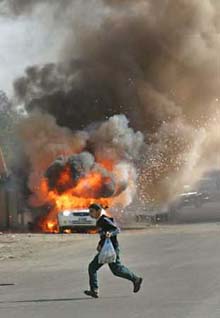
THE CRISIS IN the Middle East deepens as the Bush regime twists in the wind, offering non-solutions that even the establishment media openly question. The new Democratic majority in Congress has neither unity nor a coherent alternative. Republicans lost the November 2006 midterm election for one overwhelming reason-the U.S. population’s repudiation of the war in Iraq and the leadership that produced this disaster. Now both pro-war parties share responsibility for continuing a war that the majority of the American people want ended. Enter the long-awaited “Iraq Study Group” report. It attempts to work out how the United States can leave Iraq and stay at the same time.
WHAT’S THE DRIVING FORCE BEHIND U.S. AGGRESSION – Is it about oil? Ideology? Domestic political lobbies? Is it more a question of power and control in a unipolar world? Ismael Hossein-zadeh raises the controversial and intriguing argument that the military-industrial complex provides the primary dynamic, around which other reinforcing factors converge.
WHILE NEITHER PARTY IS WILLING TO CONSIDER immediate withdrawal of the troops from Iraq, this is the crucial debate. Even in radical circles there are some resigned to a long-term U.S. military presence in Iraq. Kale Baledock argues that the occupation both fuels the insurgency and simultaneously holds a full-scale civil war in check. Gilbert Achcar, on the other hand, argues that the longer U.S. presence continues, the more the situation deteriorates. How is the disaster of the Iraqi occupation linked to U.S. policy throughout the Middle East? David Finkel argues that the threats against Iran for its developing nuclear power while overlooking the really-existing nuclear-armed states of Israel, Pakistan and India foretell the possibility of new disasters throughout the region.
HAVE U.S. PRESENCE IN IRAQ UNLEASHED OR RESTRAINED tensions throughout the Middle East and beyond? Michael Schwartz takes Kale Baldock’s scenario of a possible regional disaster seriously but views the occupation as the principal engine that drives the region toward catastrophe. Baldock responds with the argument that the dynamics of rage and reaction in Iraq aren’t simply focused on U.S. occupation and won’t be resolved by a prompt exit.
WHAT ARE THE LESSONS antiwar activists might learn from Vietnam? David Finkel reviews three books, and compares Washington’s eventual decision to withdraw from Vietnam with the situation facing Bush today. The books provide a way to look at the differences in the eras, the wars, and the development of a domestic antiwar movement, and draw differing conclusions.
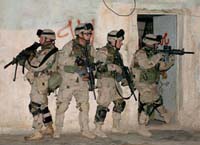
THE QUAGMIRE IN IRAQ shines the light more clearly on the crisis of Bush’s empire building. The Bush gang invaded Iraq under the guise of the war on “terror,” and quickly declared victory. George W. Bush’s imperial-messianic presidency was based on maintaining a permanent climate of fear and the image of a president who keeps the world safe. But when the populations of Iraq and Palestine, under military occupation, voted, Bush praised one result and denounced the other.
EXAMINE THE CONTRADICTIONS Of the Bush Empire through one lens and its obvious that the verbal assaults on Iran and Palestine are designed to isolate and demonize Iraq and Palestine and foster the myth that any opposition to U.S.-Israeli foreign policy is doomed to failure. The real costs of empire include not only endless wars but blend the war abroad with the war being waged on working people from Katrina through domestic surveillance. Viewed through another lens the Bush administration’s binge and hangover reveals how his team backed Israeli aggression in Lebanon and then insured that the war raged on for more than a month.
WHAT ROLE WILL ISRAEL, Washington’s ally, plays in the region, given that its army was unable to meet its objective during the Lebanon war and destroy Hezbollah? This interview with Gilbert Achcar analyzes how the Israeli army’s defeat represents Washington’s failure as well.
BACKED BY WASHINGTON to the tune of $3 billion a year, Israel has occupied Palestine since the 1967 war. Dianne Feeley, who took her first trip to the West Bank and Israel in November 2006, describes the virtual prison in which the Palestinian population is trapped. The Israeli authorities have established a sophisticated system of settlements, bypass roads, checkpoints, identity cards and a Separation Barrier that prominent figures, including former president Jimmy Carter label “apartheid.”
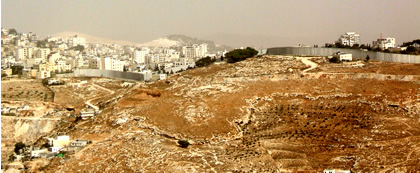
TWO PERSONAL ACCOUNTS OF PALESTINE reveal how nationhood is experienced. Tikva Honig-Parnass, a veteran Israeli fighter for Palestinian rights, reconstructs from old letters her views as a teenaged Zionist soldier in the 1948 war, when the Palestinians as a people were invisible to her as they were to most of her comrades. Anan Ameri, a leading Palestinian-American activist, remembers her reaction to the reality that it’s not just the territory of Palestine that was appropriated with the war, but the culture as well.
THE ASSAULT ON INTELLECTUAL FREEDOM, particularly the right to investigate U.S. complicity in the injustices perpetrated by Israel’s continued occupation of Palestine, is illustrated in Nadine Naber’s account of the attack on her when she publicly supported setting up a committee to consider divestment.
SOLIDARITY STATEMENTS round out our page, with a resolution on the Palestine/Israel conflict, adopted by the Solidarity National Committee in December 2000. Also included is the leaflet, “War Abroad, War at Home” in English and Spanish. You can also download Why Palestine Matters to the Antiwar Movement,” a two-page cartoon developed in April 2006.