
Posted June 28, 2009
– by Dan La Botz, June 28
The Honduran military overthrew and exiled President Manuel Zelaya on June 28, making him the first victim of a Latin American military coup since Barack Obama took office. Zelaya sought refuge in neighboring Costa Rica and is reportedly now on a Venezuela plane on his way to Managua, Nicaragua for a meeting of Central American presidents to take place on June 30. Zelaya assured his countrymen that he had not resigned.
New Working Paper: Obama, the Crisis and the Movements
Read the first draft of a report on Obama’s first 100 days online or download a .pdf.
1. Obama’s Election
Introduction: The Promise of Hope and Change
The Obama Political “Movement”
A New American Politics? Or a Return to the Clinton Years
2. The Economic Crisis
Economic Crisis
World Economic Crisis
U.S. Hegemony Tested
3. Obama’s Domestic Policies
Economy
Labor
Immigration
Education
Environment
Reproductive rights
GLBTQ issues
Communities of Color
4. Obama’s Foreign Policy
5. Response to the Crisis
Anti-war
Labor
Foreclosures
Immigrant rights
Student activism
6. The Balance of Forces Today
An Adverse Situation
The Right-Wing Reaction
7. Conclusion – The Left and Its Tasks
The Left – a Motley Crew
The Question of Program
Left Unity
The Honduran Congress selected its president Roberto Micheletti to replace Zelaya as President of the country. Micheletti has said that new elections will be held on November 29 of this year. Meanwhile tanks patrolled the streets and the military had occupied government buildings.
The recent developments began after Zelaya called for a change in the country’s constitution which would have permitted reelection of the President—though other issues are involved, such as president Zelaya’s support for economic improvements in the lives of the country’s poor. It was the call for the Constitutional referendum, however, had most recently put Zelaya on a collision course with the Congress which opposed him. Zelaya claimed the Congress was attempting to remove him through office through a “technical coup.” The situation became more serious after General Romeo Vásquez, head of the Honduran armed forces, announced that the military would not help with the election logistics. Then, on June 25, Zelaya fired the general.
President Leads March to Defend Ballots
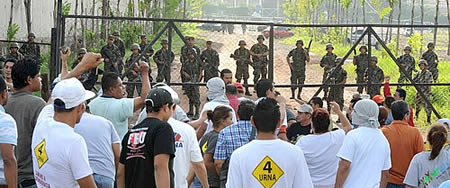
Later that same day, the Supreme Electoral Tribunal voided the referendum election and ordered the ballot boxes seized, while the Honduran attorney general’s office went to the Tegucigalpa airport to collect the impounded the ballot boxes. Learning of these developments, President Zelaya called upon his supporters to accompany him to the airport to rescue the boxes. Zelaya then personally led a march of hundreds who reportedly tore down the gates of a military base at the airport, swept past riot police, and carried off the boxes. With that, a 12-member military junta then carried out the coup. The press reported that the Honduran Congress issued a statement saying Zelaya had been removed from office for “repeated violations of the constitution and the law and disregard of orders.”
Zelaya’s referendum had been opposed by virtually all Honduran institutional powers: the Honduran Congress, Supreme Court, Attorney General, and Human Rights Commissioner, as well as his own Liberal party and the opposition Nationalist party. Finally the military too moved against him.
Latin American Condemnation of the Coup
The Organization of American States (OAS) meeting on Sunday condemned the coup in Honduras and said it would not recognize any government but that of Zelaya. The OAS Permanent Council called for the “immediate, safe and unconditional return” of Zelaya to his office. Latin American governments from neighboring Costa Rica and Guatemala to Venezuela, Cuba, Chile, Bolivia, and Brazil expressed outrage at the overthrow of Zelaya. Zelaya is expected to attempt to attend the summit of Central American Presidents in Managua on June 30; he could possibly be one of two Honduran presidents who show up there.
President Hugo Chávez of Venezuela announced that he had put his country’s military forces on alert. He promised that if a new Honduran government took office, “We will bring them down, we will bring them down, I tell you.”
The Role of the United States in Question
The United States has long dominated Central America in general and Honduras in particular, seeing it as a strategic state important to controlling the region. During the 1980s, the United States used Tegucigalpa, the Honduran capital, as a staging area for its military interventions in Nicaragua and other counter-insurgency activity in Gautemala and El Salvador. This followed a long history of U.S. military intervention in Central America, the Caribbean, and other Latin American countries, including the U.S. government’s orchestration of the overthrow of democratically elected governments of Guatemala in 1954, Chile in 1973, and its immediate support for a coup in Venezuela in 2002. Suspicion about responsibility for the overthrow of Zelaya naturally falls upon the United States.
So far, the United States has taken positions opposing the coup and calling for respect for the elected government. After being informed of the Honduran coup, President Obama told the press, “I am deeply concerned by reports coming out of Honduras regarding the detention and expulsion of President Mel Zelaya. As the Organization of American States (OAS) did on Friday, I call on all political and social actors in Honduras to respect democratic norms, the rule of law and the tenets of the Inter-American Democratic Charter. Any existing tensions and disputes must be resolved peacefully through dialogue free from any outside interference.”
“The action taken against Honduran President Mel Zelaya violates the precepts of the Inter-American Democratic Charter, and thus should be condemned by all,” said Secretary of State Hilary Clinton. “We call on all parties in Honduras to respect the constitutional order and the rule of law, to reaffirm their democratic vocation, and to commit themselves to resolve political disputes peacefully and through dialogue. Honduras must embrace the very principles of democracy we reaffirmed at the OAS meeting it hosted less than one month ago.”
Zelaya: Veteran Politician
Zelaya, a wealthy businessman involved in the lumber and ranching business, is a long-time member of the Liberal Party and former legislator, though he also represents a dramatic change from the Liberal Party’s recent past.
Liberal Party presidents have been elected in Honduras for the last five terms, generally promoting the neoliberal economic agenda and globalization. The results have been stunning. In Honduras, one of the poorest countries in Latin America, 70 percent of the population lives in poverty, according to the Inter-American Development Bank (IDB).
When one leaves the larger cities and main highways of Honduras, especially in the countryside, one walks back into the nineteenth century, a world of thatched huts and famished peasants. Honduras ranks 117 in the world on the Human Development Index (HDI), a broad definition of well-being, just behind Egypt (compared with Costa Rica, 42nd, Mexico which is 55th, and Brazil 65th). Life expectancy in Honduras is 69.8 years, while in Costa Rica it is 78.6. Per capita GDP in Honduras is $3,363 compared to $9,889 in Costa Rica. (HDI Reports for 2009).
The Hondoran Liberal Party governments have overseen a number of atrocities, including the prison fires of 2003 at El Porvenir Prison which killed 70 inmates and a second fire at San Pedro Sula in 2004 which killed 103 prisoners. In both cases most of the prisoners were members of the violent Mara Salvatrucha or other gangs and many believed that the fires had been intentionally set by the authorities. Authorities attributed the fires to overloaded electrical outlets. Witnesses claimed that those who attempted to flee the inferno were fired upon by police. President Ricardo Maduro, who had called for a clampdown on the gangs, was accused by many of being personally responsible for the fires.
Zelaya – A Break from the Past
Zelaya, however, represented a break from the Liberal Party’s past. “This is a government of great social transformations, committed to the poor,” he recently told the press. For three years he has fought with the International Monetary Fund (IMF) in an attempt to get loans for his government, struggling against the usual IMF structural adjustment policies which require cuts in the federal public welfare budget, privatization of industry, and an end to subsidies. The IMF, however would only grant short term loans, leaving the government on shaky ground as the international crisis began to affect the country.
Last December, just before Christmas, Zelaya decreed an increase in the minimum monthly wage, from 157 to 289 dollars, as of Jan. 1. The Honduran Council of Private Enterprise (COHEP), the employers’ association was furious, arguing that the higher wages had been imposed on them without negotiation. Under the Honduran labor law, minimum wage increases are supposed to be negotiated between business groups and labor unions, but when negotiations broke down, Zelaya simply ignored the law and ordered wages be increased. The country’s labor unions vowed to march in support of the wage increase.
Zelaya declared that the wage increase “would force the business oligarchy to start paying what is fair.” He also added, “I am aware it must be raised even further.”
International Labor Solidarity with Honduran People
In response to the coup, the National Executive Board of the Central American Labor Union Common Platform (PSCC), as well as several other labor union organizations (FRENADESO, CONUSI, FER-29, SUNTRACS and other union groups organized a solidarity demonstration against the coup that overthrew Zelaya and with the people of Honduras. The Guatemalan labor union organization UNSITRAGUA also issued a statement condemning the coup and calling for solidarity.