
Posted May 20, 2008

Nakba Day, 15 May, means “Day of the Catastrophe” and marks the beginning of the Palestinian exodus following Israel’s creation in 1948. Solidarity salutes the brave struggle of the Palestinian people with these reflections:
– The Nakba and the Israeli State by David Finkel
– Our strategy for Palestine by Mustafa Barghouthi [Published on Ramallah Online]
– We Should Not Celebrate Dispossession by Eve Spangler [Published on CounterPunch]
The New Orleans Workers Center for Racial Justice has begun to forge multiracial, multilingual working class solidarity throughout the city and region – among guest workers, day laborers, homeless people, and public housing residents. In the process, these organizing projects challenge the larger labor movement to reconsider its dominant organizing framework.
For almost 75 years, unions have looked to the Wagner Act, or National Labor Relations Act, as a basis for labor rights – and neglected the use of the 13th Amendment, which prohibits involuntary servitude. In doing so, unions acknowledge the primacy of property rights; the NLRA is built on the Commerce Clause. The Act also does not cover agricultural, domestic, and other sectors of the workforce that are largely women and men of color. In the years that followed, this weakened effective solidarity between largely white industrial workers and the working class as a whole.
As organizers, we often use “rights rhetoric” – highlighting the legal right to strike and the illegality of employer interference in agitation. However, the only way these rights are ensured is through appropriate action. In the 1930s, this meant sit-down strikes and other militant tactics. Today, after decades of union-employer partnership, rights outlined by the NLRA have been whittled away by amendments, case law, and prevailing anti-union Board interpretation. The all-out offensive of capitalism over the past thirty years, called neoliberalism, has driven down wages, deskilled labor to make workers easily replaceable, and globalized the work force demands. In this new environment, we should consider looking backward.
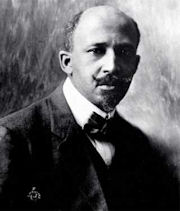
In his classic work, Black Reconstruction, WEB Dubois asserted that enslaved people refusing to work the fields in the midst of the Civil War were on strike. Immigrants under today’s guest worker programs increasingly find themselves in slave-like conditions. Guest workers demanding 13th Amendment rights – while also organizing mass action – recapture a forgotten legal basis for workplace rights and offer another useful framework for alliances between immigrants and African Americans.
Fighting back in the Strawberry Fields
On Valentine’s Day 2008, thirty Mexican H2A (agricultural) “guest workers” in Amite, Louisiana walked off the job to protest the slave-like conditions in the strawberry fields and reclaim their dignity.
Strawberry picking is back-breaking work. The men were bent down over bushes for hours while there boss, Charles “Bimbo” Relan paid as little as $2 an hour for piecework. When they stopped to stretch, “Bimbo” yelled that he would deport them to Mexico. The workers were not given water or allowed to use the bathroom. With the boss holding their passports, the workers mobility was limited. And under US law, H2A workers must stay with the employer specified on their visa. So they had a choice: work under slave-like conditions, or go back to joblessness and poverty in Mexico. Instead, they decided to organize.
The thirty men had been recruited from the indigenous community of San Luis Potosin, Mexico. Trade agreements such as NAFTA destroyed their local economy and pushed these workers to pay recruiters nearly $1000 for the “privilege” of finding work.
In solidarity, a delegation of African Americans attempted a citizen’s arrest of Relan for violating the federal laws that define slavery, peonage, human trafficking, and servitude in the United States.
Bimbo struck back: he was forced to return the passports, but fired the workers and illegally evicted them. The Department of Justice has opened an investigation on Relan for human trafficking. Since the actions, pickers continue to organize. Some moved in the wake of the firing and eviction, but other Mexican Strawberry pickers in the area were inspired to organize.
Indian H2B Shipyard Workers organizing in Texas and Mississippi
1. Wednesday, May 21 nation-wide solidarity actions on the week anniversary of the strike. Possibilities for actions include one-day solidarity fasting; prayer vigils; public educational events; petitioning. Please report your action plans to Krista Hanson, krista@jwj.org as soon as possible so we can report all actions to the workers and to the media. There will be a major rally and press event on that day in Washington D.C.
2. Petitions and delegations to Congressional offices. There is a sign-on letter that Congressional Representatives and Senators will send to the Department of Justice calling for the granting of continued presence for the workers in the U.S. Solidarity activists can gather signatures on the petition and then deliver it to Representatives’ offices. The petitions can be delivered on May 21, and again during the week of May 27-30, the congressional recess when Reps are in their home offices.
3. Raise money for the strike fund. The workers are putting in tens of thousands of dollars to make the hunger strike possible, and they need funds to pay for transportation, housing, and all the other
logistical support. Click here for information on contributing.
4. Visit the workers if you are in or near Washington D.C. There is a schedule of where to find them on the website for DC Jobs with Justice.
These workers paid recruiters up to $20,000 on a promise from recruiters- in New Orleans, Mississippi, and Mumbai- of good jobs, permanent residency, and a chance to bring their families to the US. Workers sold their homes, took high-interest loans, and plunged their families into debt to pay for the American Dream. But again, when they arrived, they found that all the promises were false. They were brought to Gulf Coast shipyards of Signal International on 10-month visas, forced to pay over $1,000 per month to live in labor camps (temporary company towns) up to 24 to a room, in horrific conditions. When they asked for improvements, they were humiliated by managers who told them that they had nothing to complain about: surely this was better than the way they had lived in India.
These workers organized for more humane treatment and the company responded by sending armed guards into the labor camps, pulling the organizers out of bed, holding them captive and calling the police with the intention of deporting them. The pressure of being deported back to India with a $20,000 debt waiting at home drove one of the organizers to attempt suicide.
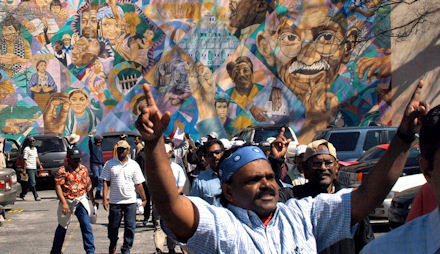
Indian Shipyard Workers on Strike!
On May 9, 2007, 300 workers went on strike to demand the release of their organizers. The company backed down, released them – and fired them. The company then ran an intimidation campaign on its employees, forcing the workers to quiet down and accept the conditions of labor trafficking. Indian Worker Congress continues to organize to fight international labor trafficking.
On the evening of March 5, 2008, almost 100 Indian workers met for almost four hours in a filled a Pascagoula hall to discuss plans for the next day’s action. Workers planned for their upcoming action in Hindi, Tamil, English, and Malayalam. The next morning, workers still employed by the company walked off the job- symbolically turning in their hard hats at the company gate to call attention to their continued abuses under the H2B visa program.
Signal workers initiated litigation against the labor recruiters and ongoing actions in the U.S. and India. After a tour through Civil Rights history in the Southeast, the workers arrived in Washington DC where they have began a hunger strike in front of the Indian Embassy and White House. The hunger strike indicts the flawed H2B visa system as a form of indentured servitude, demanding that the U.S. and Indian governments meet to implement a more equitable labor exchange, asking for a guarantee of safety for themselves and their families, and demanding that Congress halt H2B expansion until a thorough Congressional investigation of abuses under the program is done. They repeat their call for the Department of Justice to prosecute their former employer, Signal International.
Forming a new regional & multiracial working class unity
The Workers’ Center organizes through leadership schools, teach-ins, and trainings both at the office and in community spaces. The center focuses on building in opportunities for solidarity actions. On March 6, a social event linking the Indian worker struggle to New Orleans organizing was attended by Jornaleros (Day Laborers), Brazilian shipfitters, local Black leaders, homeless community members, public housing residents, a SNCC veteran, and reconstruction activists in addition to the Indian workers. Attendees spoke Spanish, English, Tamil, Hindi, Portuguese; they shared stories, music, and camaraderie. Attendees agreed that the fight they share is a fight for freedom and human liberation embodied in the 13th amendment.
For more information on the Alliance of Guestworkers for Dignity and the New Orleans Workers’ Center for Racial Justice , visit
- http://www.neworelansworkerjustice.org
- http://www.myspace.com/neworleansworkerscenter