
Posted April 1, 2009
In their essay “Reimagining Socialism,”
Barbara Ehrenreich and Bill Fletcher point to the need for solidarity and organization if we are to respond to the current crisis and undertake what they call “the great project of collective salvation.” And right they are. So how are we to do it?
More than 100 years ago, Jack London wrote: “We are all tied to the same machine—only some of us are tied to the top.” And that, of course, makes all the difference.
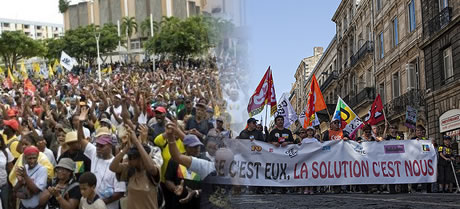
General strikes in Guadeloupe and France
Further Reading
The ideas in this piece, which appeared in edited form in The Nation, are expanded and placed in historical context in an essay for the Mumbai Economy and Political Weekly, “The World Crisis, Capital and Labour: The 1930s and Today.” Read it online or download a PDF to print.
Other articles in the Nation’s Forum on Reimagining Socialism:
- Barbara Ehrenreich and Bill Fletcher, Jr., “Rising to the Occasion”
- Immanuel Wallerstein, “Follow Brazil’s Example”
- Bill McKibben, “Together, We Save the Planet”
- Rebecca Solnit, “The Revolution Has Already Occurred”
- Tariq Ali, “Capitalism’s Deadly Logic”
- Robert Pollin, “Be Utopian: Demand the Realistic”
- John Bellamy Foster, “Economy, Ecology, Empire”
- Christian Parenti, “Limits and Horizons”
- Doug Henwood, “A Post-Capitalist Future is Possible”
- Mike Davis, “The Necessary Eloquence of Protest”
- Lisa Duggan, “Imagine Otherwise”
- Vijay Prashad, “The Dragons, Their Dragoons”
- Kim Moody, “Socialists Need to Be Where the Struggle Is”
- Saskia Sassen, “An Economic Platform That Is Ours”
- Joanne Landy, “I Love Bill Moyers, but He’s Wrong About Socialism”
- Dave Zirin, “Socialists, Out and Proud”
- Hilary Wainwright, “There Is An Alternative”
The crisis of capitalism which we are experiencing unfolds as two parallel crises. One crisis for them, the corporate elite, the CEOs and CFOs and the Boards, their lobbyists and politicians, and all those who make up the upper echelons of American economic, social and political life. And another crisis for us, often called “the middle class,” but better described as our country’s working people and, of course, the poor. (And, by the way, there is no such thing as “everyone sharing the pain” or “equality of sacrifice,” because in our society there is not and has never been equality, nor has there been much sharing.)
The Crisis Begets a Struggle
The crisis has quickly led to a struggle between the two groups, first, over the question of who will pay for the crisis; second, over how the economy will be reorganized through the crisis, and, third, over the new state of affairs that will prevail when the crisis ends. They want us to pay for the crisis, of course. Meanwhile, they want to consolidate economic power through the crisis, while we lose our homes. And, finally they want a new state of affairs tomorrow that will return them to profitability—and leave us broke.
The auto bailout, for example, is conditioned on union givebacks. New Jersey Governor Corzine wants wage freezes and furloughs—and the public sector unions are announcing their willingness to compromise. New York City Mayor Bloomberg is talking about increasing healthcare premiums for city employees and creating a new pension tier. As President Obama’s advisor Rahm Emmanuel said, “Never let a crisis go to waste!” Not when it can be used to enrich them and to impoverish us.
So a struggle has begun, but it is an unequal contest. The corporate elite has run this country for a hundred years, controls all the governmental machinery, dominates the two major political parties, the lobbyists, and business and commercial associations. We have…well, in truth, we don’t’ have much except our numbers and our disparate locations in the workplace, communities, and society of working class America. Yet we cannot hope to change this society unless we can build a movement with the power to do it.
The Militant Minority
How do we use what little we have in this unequal fight over the future of our country? How in the face of their vast economic and political power do we build a people’s power to confront them? We believe the answer is for socialists to work to build and to support militant minorities. Think of the Abolitionists. Think of the sit-down strikers. Think of Martin Luther King, Ella Baker, and César Chávez.
Or take the workers at Republic Window in Chicago and their union, the United Electrical Workers (UE) as an example. Those workers refused to accept the closing of their plant. But they didn’t just file a grievance. Or bring a law suit. Three hundred workers in one factory organized democratically, from below, and built a grassroots movement that took action. They trespassed, seized private property, occupied a factory, called for solidarity, and got it, and in the end they kept their jobs and for a brief moment inspired working people throughout the country and the world. (www.ueunion.org/index.html) Small movements such as these, accumulating momentum, will set in motion the larger forces with the power to change the world.
Set Larger Forces in Motion
The task of socialists today is to build and support such militant minorities so that tomorrow we can set larger groups into motion. Why set larger forces in motion? Because as we know from history, when large numbers go into motion they develop new the tactics and strategies as well as the new political alternatives without which we cannot succeed in changing this society. Most important, when millions go into motion, they actually have the power to change society. And as a powerful opposition movement grows it will inevitably tend to become political, challenging the powers-that-be. But it will not inevitably become socialist.
More often than not, in this country, the Democratic Party has succeeded in capturing and taming movements striving to break to the left, toward socialism. The function of the Democratic Party, today the party of Barack Obama, is to ensure that his slogans of hope and change do not become a reality. Yet, ironically, at the same time, it is the hope for change which they will use to keep the movements in tow. While people believe that there is hope within the Democratic Party, many will find it hard take independent action to make change. Our job as socialists is to show them that there is hope, but it is in themselves, in the movements they build and the plans them make.
Build an Independent Movement
Rebuilding the Antiwar Movement
For the first anti-war demonstration in more than a year, Solidarity released a statement outlining some ideas on rebuilding the antiwar movement in the United States: Between Crisis and Hope: Rebuilding a Movement to Bring All the Troops Home Now.
One needs only to look at the anti-war movement to see this happening. Obama has extended the date for withdrawal from Iraq, and now foresees leaving an occupying army of 50,000 troops. He plans to augment the forces in Afghanistan by 30,000 troops. And, his government is carrying the war to Pakistan. The war is expanding, and some in the leadership of the anti-war movement have been reluctant to demonstrate against the Obama administration. Yet throughout the country the militant minorities within the anti-war movement have demanded action and strive to act to set the larger forces of the broader movement in motion. In doing so, they are also be helping the movement to chart an independent course.
We see building of the militant minorities as the way today to rebuild a socialist movement. What is today a loose network of such ginger groups in the various movements throughout the country can be drawn together to become the socialist movement of the future. We in the left should work together on this task together, so that even as we rebuild the movements, we also unify the left and build a new socialist movement to confront the crisis.
Dan La Botz is a Cincinnati-based teacher and activist and a leader of Solidarity. An edited version of this piece appeared in a forum on Reimagining Socialism in The Nation under the title Militant Minorities.