
Posted May 29, 2009
This December in Copenhagen, the United Nations Climate Conference will determine the international agreement on climate change to succeed the expiring Kyoto Protocol. Since the signing of Kyoto in 1997, total global emissions from 1990 levels have not decreased. Emissions in the United States, which did not ratify Kyoto, rose by 20%. Emissions in the former Soviet Union and Eastern European countries declined dramatically, but only due to the collapse of Stalinist “communism.” More CO2 continues to build up in the atmosphere.
These have also been the years of severe droughts, devastating storms along equatorial coasts, melting sea ice, species migration and extinction, and growing scientific and activist consensus regarding the nature of the crisis and the drastic measures needed to confront it. A climate justice “movement of movements” is gathering, and we need to organize and demonstrate leading up to and at the Copenhagen meetings, demanding an end to pro-market “business as usual” solutions and for one of the most fundamental social transformations ever in human history.
To find out more, check out the Global Climate Campaign, and sign this appeal.

During the Kyoto years (1997-2007) over 180,000 Indian farmers committed suicide. Each day 46 more kill themselves, many by ingesting pesticides and toxic fertilizers.
These farmers are drowning in debt with no prospect of repaying. To secure loans from agencies like the World Bank and International Monetary Fund (in order to repay previous debts!), governments in the global South withdrew subsidies and price controls that guaranteed an outlet for their product and support against droughts or floods. Now competing in an international food market, farmers are forced to take out loans to purchase implements, fertilizers and seeds from multinationals like Monsanto and Cargill. As monoculture farming continues to exhaust the land, farmers arrange for additional loans in order to extend their acreage and drill more wells in last ditch efforts at survival. A single bad harvest or price swing is enough for hundreds to see suicide as their only way out.
Alongside the rapacious rule of multinational corporations and their “free market,” there is another dimension to this tragedy. Officials and specialists are recognizing that climate changes affect seasonal rainfalls, and that areas in India and Australia are already suffering from long-term – maybe even permanent – drought. These farmers are not just victims of the global economy but also ecological casualties caused by industrial capitalism’s assault on nature.
The main contours of the crisis are widely acknowledged. Due to industrial capitalism’s burning of fossil fuels, carbon dioxide levels in the atmosphere have risen from a pre-capitalist-industrial level of 280 parts per million to 385 ppm. The warming caused by this increase in greenhouse gases has varied and interrelated effects – melting arctic ice and mountain glaciers, drying rivers and rising sea levels, species extinction and the disruption of agricultural cycles. Conservative estimates warn that total global emissions of CO2 must be reduced by 50%-80% by 2050. Climatologist James Hansen predicts that any prolonged period above the 350ppm may alter the earth’s climate. We are on the brink of catastrophe.
The Intergovernmental Panel on Climate Change predicts that 150 million people will be made “climate refugees” by 2050. Along with the world’s traditional and indigenous peoples, the vast majority will be women and children in coastal areas of the global south. Much of the land in Latin America and Africa is already at its temperature “tipping point” – with any increase bringing drought, massive impoverishment and starvation. Rising sea levels would submerge coastal cities across the globe, and warming would destabilize farming in the developed world as well. As the aftermath of Katrina demonstrated plainly, the effects of climate change do not befall humanity evenly.
Ecocidal Capitalism and Ecosocialism
After the pillage-and-burn-the-planet politics of George W. Bush, President Barack Obama’s pro-environmental stance looks to millions of people like a godsend. Besides cancelling some drilling leases on protected lands and announcing higher fuel-efficiency automobile standards, the president and Congressional Democrats are promoting cap-and-trade legislation where industrial emission allowances can be bought and sold on the open market, hopefully leading to a decline in total emissions.
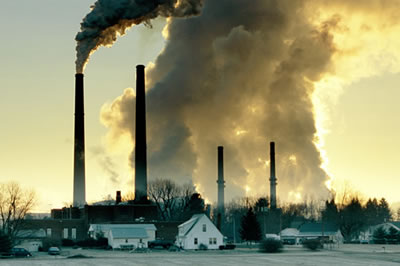
But precisely because this program seeks to save the environment through the “logic” of the capitalist “free market,” it cannot possibly bring about the enormous reduction of greenhouse gases or the huge transformations in production that are required to prevent the looming catastrophe.
Capitalism is an undemocratic, competitive economic system based on the accumulation and expansion of profit. The capitalist who profits the most – and thus “wins” – is the one who can exploit the deepest (i.e. with the lowest costs of production) and “exchange” the most value. These profits are then reinvested in the production-exchange process all over again, on an ever-expanding scale. What is produced – the “use value” – is irrelevant. There is no logical limit to this process of production and accumulation. In this process, both nature and the worker are what business calls “externalities,” to be literally used-up – “degraded,” Marx says – for the sake of expanding capital. As Joel Kovel puts it, capitalism is inherently “ecocidal.”
It is impossible to maintain this system, founded on exploitation and accumulation, and socially organize solutions to avert a global climate catastrophe. Global emissions need to be reduced by drastic levels in the next decades, and the fossil-fuel driven economy “decommissioned” entirely by century’s end. This cannot be done without marshalling massive public funding, democratizing resources and technologies to the global south, and profoundly reducing energy consumption in the developed industrial countries. It is a bourgeois fantasy to think that the global industrial capitalist production-distribution system can or should remain intact.
Capitalism can only respond to particular symptoms of the crisis, not its root causes. The basis of the Kyoto Protocol, Obama’s climate change policies, and all pro-capitalist “solutions” is the “cap and trade” system, which allocates emission allowances. Companies which exceed their allowances need to purchase “credits” from others who manage to emit less. This system does not reduce emissions at their source, but assumes companies will chose to emit less. A company can well exceed its allotted emissions, and “cover” this excess by funding an NGO which is protecting a forest preserve in Brazil (probably dispossessing the local population there). In many cases, the Kyoto signatory governments allotted more allowances than there were emissions and manipulated credit prices, as the Financial Times has admitted.
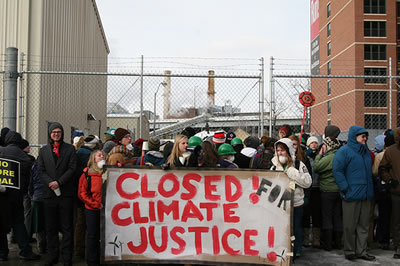
We need a politics capable of adequately understanding the interrelations between the present ecological crisis and extractive-exploitative capitalism. We need a politics that can build a world based on democratic, egalitarian and social solutions to the contradictions posed by the crises. We need to imagine a fundamentally transformed human society, based on the democratically determined and de-alienated production of use values and an ecological relationship with nature that is neither extractive nor pollutant.
What are we to do today?
-
Build all movements in an ecosocialist direction –Stronger labor and campesino movements, anti-racist and anti-neocolonial struggles, women’s and LGBTQ organizations, can strengthen one another and put a more radical and wholistic transformatory politics on the table. Struggle itself teaches and establishes connections with other movements.
The economic crisis discredits neoliberalism and lays bare many of industrial capitalism’s contradictions. With the finance bailouts and U.S. auto industry crisis, we are tasked with exposing the wasteful, undemocratic and oppressive character of the rulers’ solutions and with imagining what can be transformational alternatives (mass public transit vs. private individual cars, or public provision of health care and education vs. transfer of the public treasure to private financial institutions).
-
‘Green’ Jobs? – Yes! But not to make more stuff – The combined economic crisis and the enormous effort needed to transform our productive and social infrastructure will require a massive jobs program. ‘Green jobs’ is not just a neatly coincident notion to confront endemic poverty and unemployment due to the economic crisis and end our economies reliance on fossil-fuels. It is ecologically and socially necessary.
We demand a massive federal public jobs program, funded by appropriations and restrictions on capitalist profits. Integral to such a jobs program is the defense and expansion of socially reproductive labor and services – caring work, health care, education, sanitation, transportation, etc. The built-in “plant” of the industrial capitalist world is a wasteful ecological nightmare and we need to disabuse ourselves of the Western, techno-commodity fetishism which always and only tells us that more and better stuff can repair the world and make our lives whole.
-
Join and Build the Climate Justice Movement – Leading up to and on Earth Day this year, hundreds of protests around the country were organized at existing or planned coal plants to demand an immediate moratorium and fast phase-out of coal burning (see the CMNOW link below). ‘350,’ the now internationalized network founded by Bill McKibben and others, is calling for mass actions this October 24 to demand immediate measures to bring down CO2 to 350 ppm. We need an international show of force ahead of, and at, the December Copenhagen meetings, where the world’s leaders are to determine the agreement to follow the failed Kyoto Protocol.
Socialists have crucial roles to play. We emphasize the need for democratic movements of mass struggle – not for aesthetic reasons, but because this is the only way we can win. A dialectical, historical-materialist ecosocialist politics can both diagnose the crisis and point a way towards a human and ecological future.
Resources
Capitalism and the Climate Catastrophe
Climate and Capitalism (blog run by Ian Angus)
‘Hothouse Earth — Capitalism, Climate Change, and the Fate of Humanity’ (2-part article by Chris Williams in International Socialist Review, #62 and #64)
Ecosocialism
Ecosocialist International Network (includes the Belem Ecosocialist Manifesto)